Buy subscriptions
Customers can sign up and choose a plan themselves
For SaaS companies, cleaning services, IT businesses, fitness centers and others with recurring agreements. Alunta manages your subscriptions so you can focus on your business.
Alunta is 100% free to try and requires no credit card to get started.
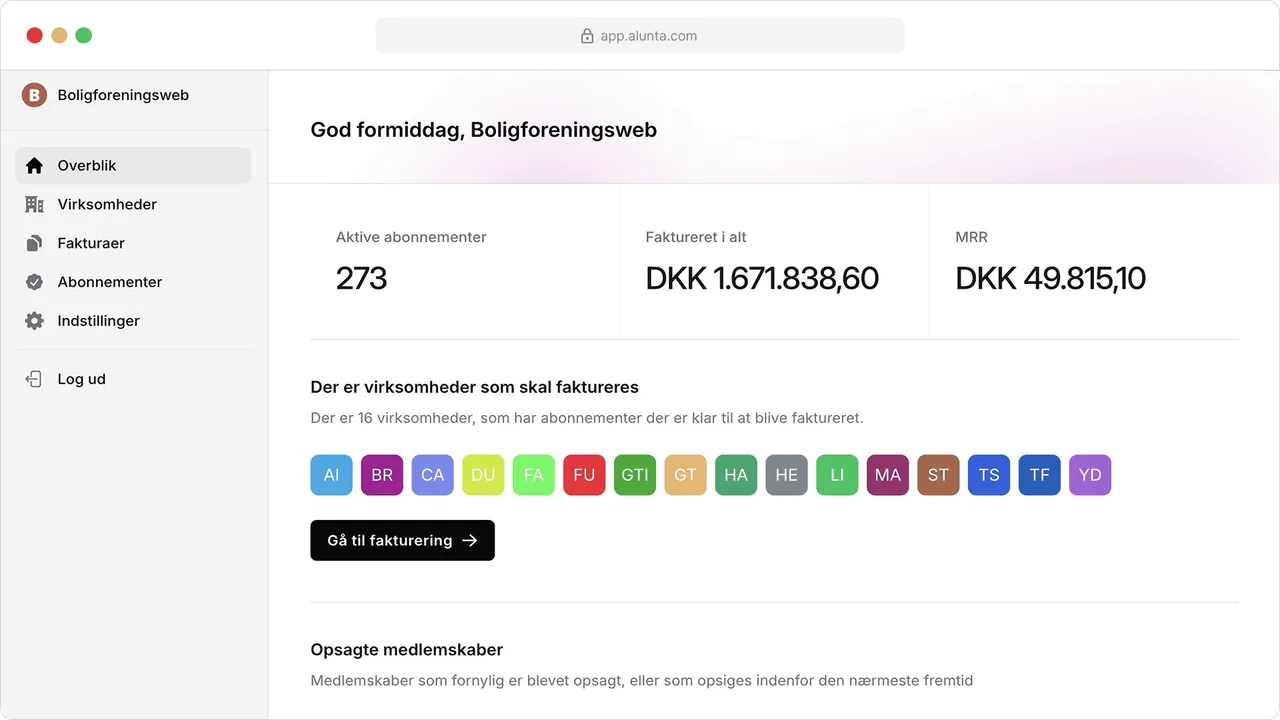
We are proudly at the core of multiple businesses




How it works
Set up your subscriptions and customers. Alunta invoices, collects and posts — automatically or with your approval.
You do
And then...
Alunta does
New customer created
Hansen & Co. Ltd
Invoice #1234 sent
Møller Cleaning Ltd
Payment received
€299.00 — Card
Posted to e-conomic
Invoice #1234
Invoice #1235 sent
Nordic Services A/S
MobilePay payment received
€99.00
Posted in Dinero
Invoice #1235
Reminder sent
Invoice #1201 — 14 days
Direct debit collected
3 customers — €995.00
Posted in Billy
3 invoices
New customer created
Hansen & Co. Ltd
Invoice #1234 sent
Møller Cleaning Ltd
Payment received
€299.00 — Card
Posted to e-conomic
Invoice #1234
Invoice #1235 sent
Nordic Services A/S
MobilePay payment received
€99.00
Posted in Dinero
Invoice #1235
Reminder sent
Invoice #1201 — 14 days
Direct debit collected
3 customers — €995.00
Posted in Billy
3 invoices
New customer created
Hansen & Co. Ltd
Invoice #1234 sent
Møller Cleaning Ltd
Payment received
€299.00 — Card
Posted to e-conomic
Invoice #1234
Invoice #1235 sent
Nordic Services A/S
MobilePay payment received
€99.00
Posted in Dinero
Invoice #1235
Reminder sent
Invoice #1201 — 14 days
Direct debit collected
3 customers — €995.00
Posted in Billy
3 invoices
Customer portal
Alunta gives your customers their own portal. Less support for you, better experience for them.
Customers can sign up and choose a plan themselves
Switch plans instantly — pricing adjusts automatically
Full overview of invoices and payment history
Card, MobilePay or direct debit — the customer chooses
Unlike Stripe Billing, Alunta supports local accounting, direct debit and MobilePay — and requires no developers.
Connected to
 e-conomic
 Dinero
 Billy
Billy Business Central
 Stripe
 OnPay
OnPay QuickPay
 MobilePay
Built for the whole world
Alunta runs subscriptions across borders. Invoice your customers in more than 30 currencies with daily exchange rates — converted automatically.
Daily exchange rates - updated automatically.

Australian dollar

Brazilian real

Canadian dollar

Swiss franc

Chinese yuan

Czech koruna

Danish krone

Euro

British pound

Hong Kong dollar

Hungarian forint

Indonesian rupiah

Israeli shekel

Indian rupee

Icelandic króna

Japanese yen

South Korean won

Mexican peso

Malaysian ringgit

Norwegian krone

New Zealand dollar

Philippine peso

Polish złoty

Romanian leu

Swedish krona

Singapore dollar

Thai baht

Turkish lira

US dollar

South African rand
Alunta speaks a whole range of languages too. Right now we support Danish, English, German, Swedish and Norwegian. Missing yours? Tell us - and we move fast.
Curious about how to add more automation and flexibility to your subscription workflows? Take a look at our most popular features.
Show me all features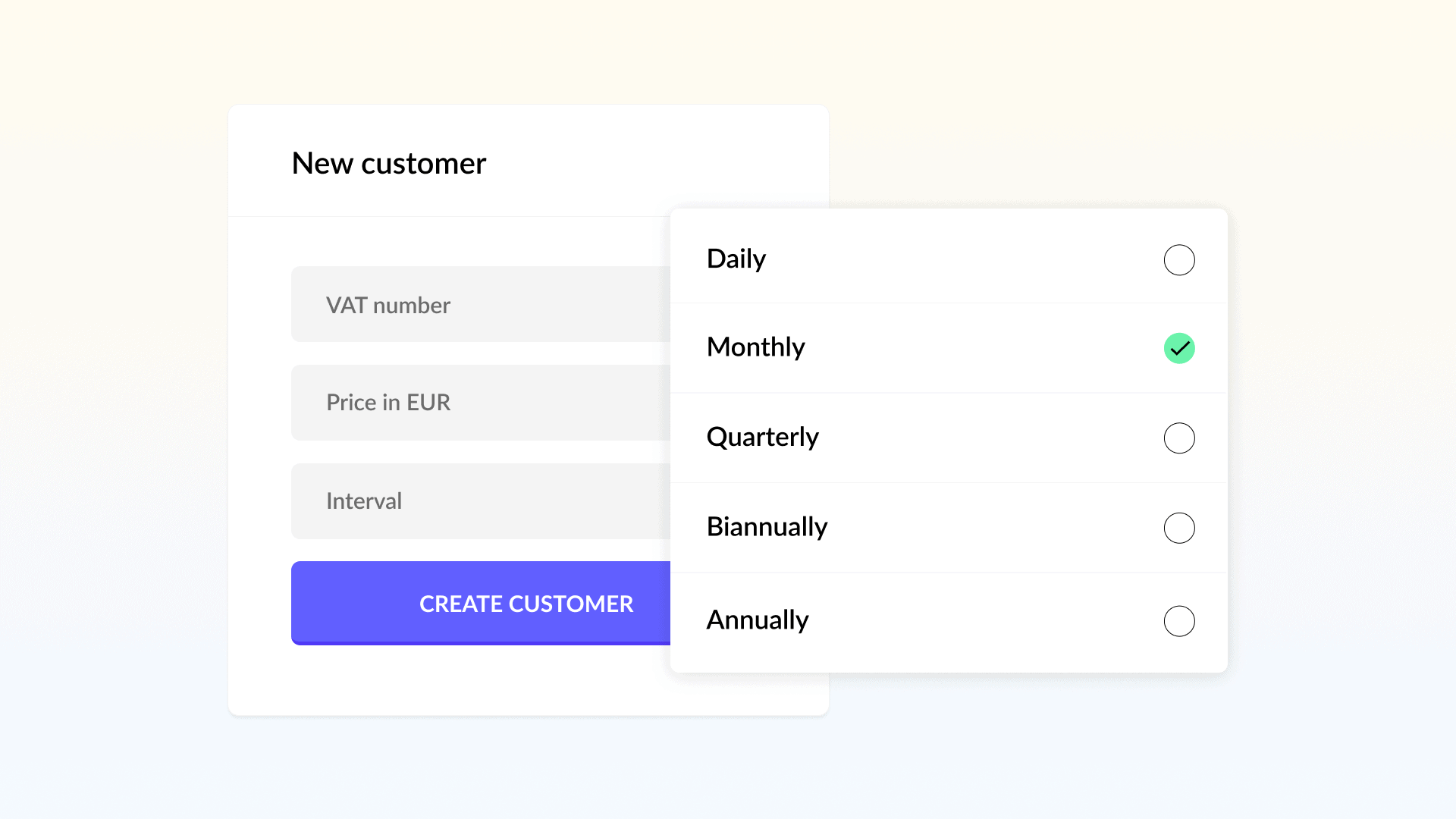
Enter the customer’s company ID, subscription, and renewal interval. From there, Alunta creates the invoices automatically.
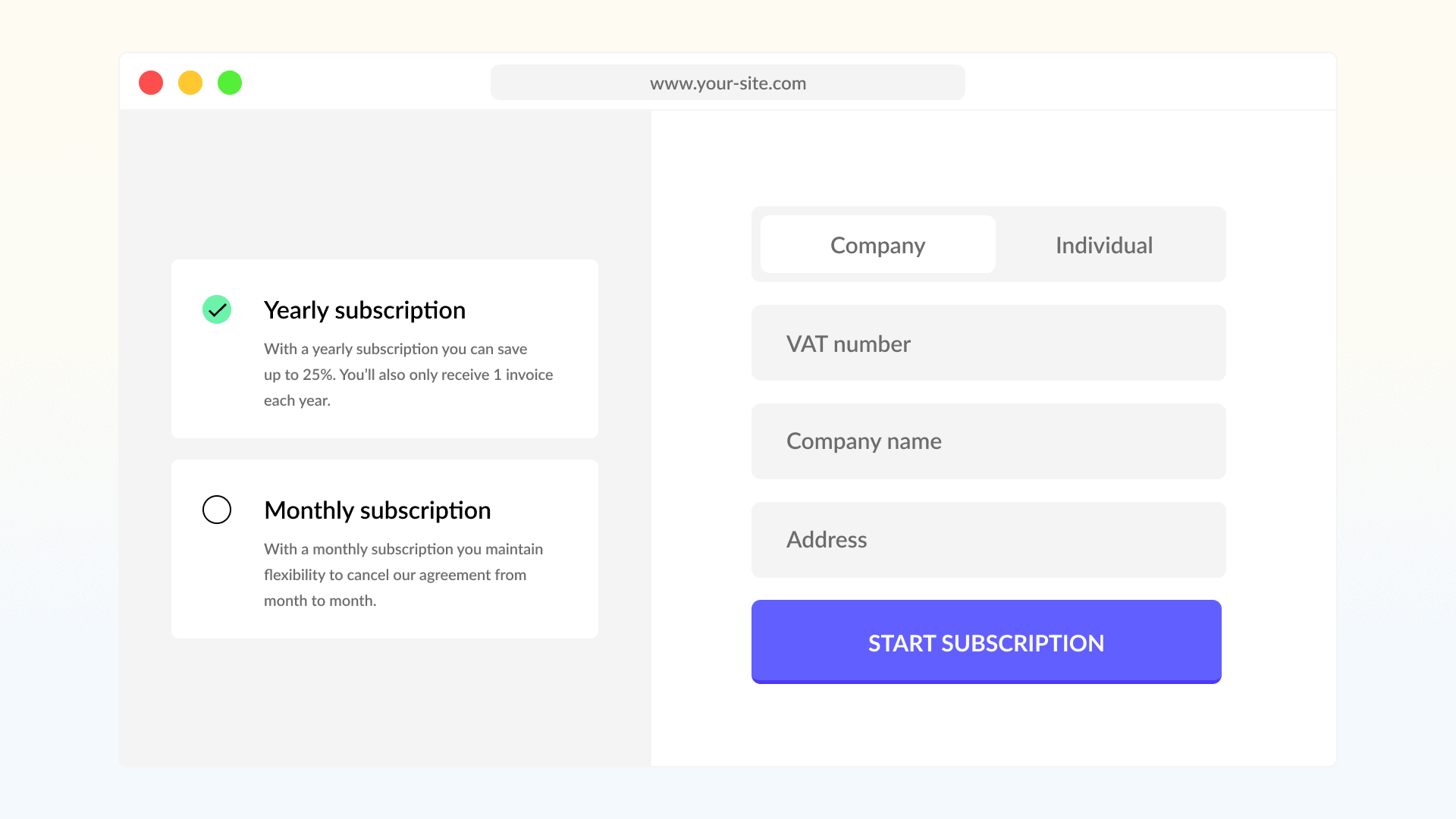
Place Alunta on your website and sell your subscriptions online. Add a picture and description to make it special.
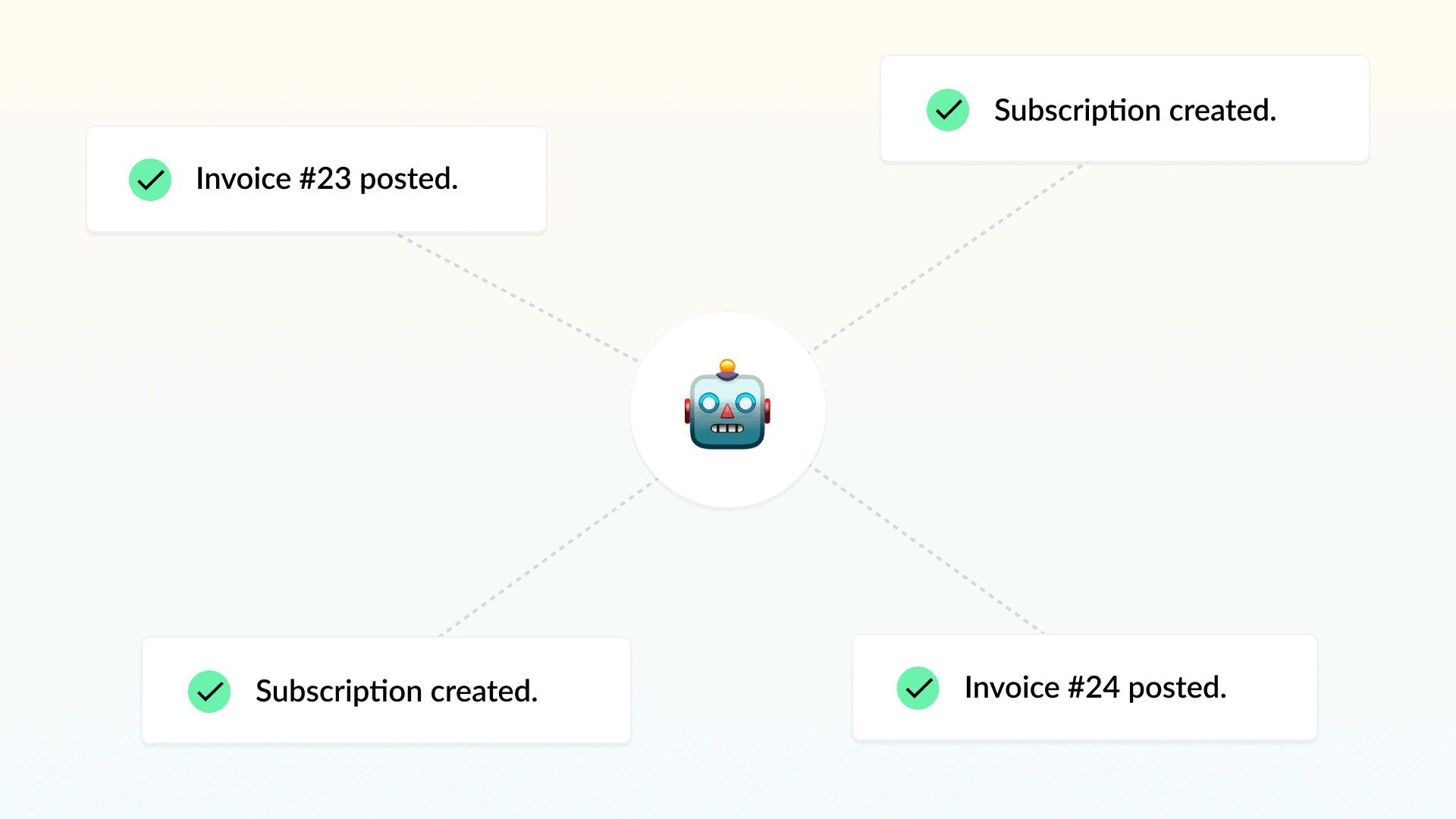
All invoices are pushed directly into your accounting system. No need to worry about accruals, reconciliations, or anything in between.
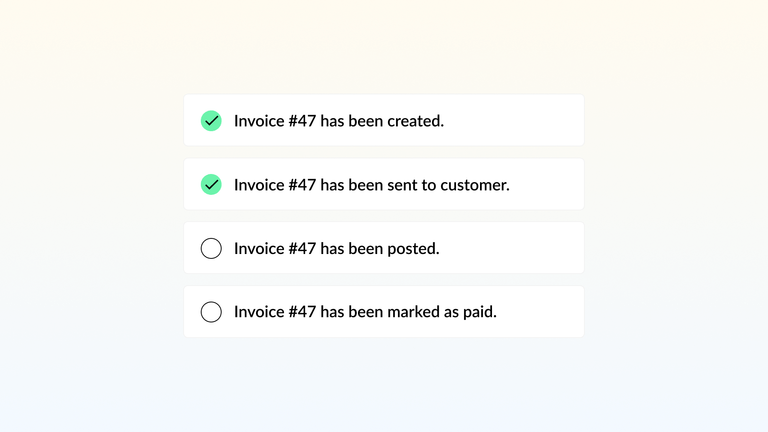
A feature made especially for you that likes to be in control. Alunta will prepare all the paperwork but you'll have the final say and press "Go!"
The modern developer’s best friend
Point your AI tool at our docs and it builds the integration for you. Alunta is built to be read by machines - clean REST, a machine-readable llms.txt and a full OpenAPI spec.
Try it - paste the prompt into your AI tool
Build an integration with Alunta. First read https://alunta.com/llms.txt and the API docs at https://app.alunta.com/docs/v1. Then write a script that creates a new subscription whenever a user signs up in my app.
Works with your tool
 Claude Code
 Cursor
 Lovable
 Codex
Codex Windsurf
 v0
v0Want your AI to dig deeper? See our llms.txt, or give it the full API spec.
We were simply tired of endless spreadsheets full of color codes and formulas. It was nearly impossible to track which customers had to renew and at what price. If that sounds familiar, Alunta might be for you. We believe in automation – and we’ve turned it all the way up. With Alunta, you can automate invoice creation, sending, and bookkeeping.
Want to know more about us?
It’s hard not to sound too “cheesy” or “big-corp” here, but we really believe in making a difference for our customers.
“We have for years worked with update agreements, hosting, and service agreements at Twentyfour. We have 100+ customers who need to be invoiced regularly for the agreements we have, and without Alunta it’s nearly impossible not to make mistakes when the correct invoices need to be issued every month.”

“Anyhoa was the first customer on Alunta.com. The reason is that the people behind Alunta are also the ones behind Boligforeningsweb.dk. We’ve been able to replace our large spreadsheet with a reliable system, where invoicing is no longer something we have to spend our time on.”

Alunta makes it simple. Super simple. Any business with subscriptions or service agreements can automate billing and payments. You get a solution that keeps everything in one system and saves you time.

With Alunta, you can manage all your student payments without the hassle. Automate invoices and subscription management so you can spend your time developing amazing courses – and ensure a stable income every month.
Read more about online courses (e-learning)
You know that your clients' employees' workday depends on the lunch menu. Make sure you have as much time as possible to deliver delicious food and have automatic subscription management.
Read more about catering company
With Alunta, property service companies can take administration to a whole new level. From easy invoicing to accounting – we make sure you have the boring stuff under control so you can concentrate on what's important.
Read more about property service
Don't get stuck in spreadsheets and manual invoicing processes that your customers are stuck on the side of the road. Systemize and automate invoicing!
Read more about road assistance
With Alunta, your sports association is free from the heavy administrative work and has more time to focus on the sport. Whether you have a small club with few members or a large association with many, Alunta makes operations easier.
Read more about sports association
Alunta makes it easier to keep track of a magazine or newsletter by handling all the practical things that happen after the content is sent out. It's a smart solution if you want to stay on top of things and still have time for creativity.
Read more about magazines and newslettersPricing that fits everyone
Everything you need to manage subscriptions, invoices and payments. Ready in under 5 minutes.
Alunta Free
0 kr
/ mdUp to 10 customers
Up to 10,000 DKK MRR
Included in all plans
At1.000DKK MRR/mo
Based on public list prices. Stripe Billing 0.7% of volume. Chargebee Performance DKK 4,200/mo + 0.75%. Recurly Core DKK 1,400/mo + 0.9%. Bookkeeping estimated at ~DKK 500/mo. Excluding payment fees.
Used by Obsidian, IDguard.dk, mahope.dk and many more
Found a cheaper solution? We'll match the price. Always. Don't fit into a plan? Contact us.
In doubt? Talk to Oliver before you decide. Write to Oliver.
| Plan | Price | Max customers | Max MRR |
|---|---|---|---|
| Alunta Free | 0 DKK / mo | Up to 10 customers | Up to 10,000 DKK MRR |
| Alunta Starter | 199 DKK / mo excl. VAT | Up to 25 customers | Up to 50,000 DKK MRR |
| Alunta Growth | 499 DKK / mo excl. VAT | Up to 100 customers | Up to 150,000 DKK MRR |
| Alunta Scale | 1,499 DKK / mo excl. VAT | Up to 500 customers | Up to 400,000 DKK MRR |
| Alunta Pro | 2,999 DKK / mo excl. VAT | Unlimited customers | Unlimited MRR |
Start automating billing and bookkeeping today. Create a free account and experience how simple it is to handle subscriptions and service agreements with Alunta.
Try for free

Oliver LindebodCo-founder, Alunta